Europe’s moment of truth arrives in Caracas
From Venezuela to Greenland, Washington is treating allies as territory to manage — forcing the EU to decide whether it will stand by its principles or be ruled by US power politics.
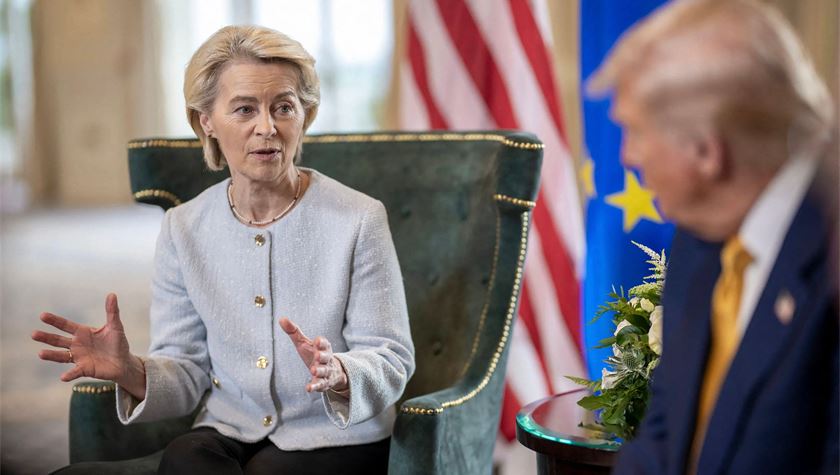
US President Donald Trump and European Commission President Ursula von der Leyen at the White House, Washington DC, July 2025 (Pictorial Press Ltd/Alamy)
By Paula Soler
Washington’s snatch-and-grab in Venezuela is the most dramatic proof yet that Donald Trump’s White House sees the world through spheres of influence, a worldview closer to Vladimir Putin’s than Europe’s.
Following the US’ unilateral move to capture Venezuela’s president, Nicolás Maduro, in a spectacular raid in Caracas, the EU’s reaction was cautious. Twenty-six member states — Hungary abstaining — urged respect for international law and Venezuela’s democratic will but stopped short of condemning the operation.
“The EU must defend the international rules-based order clearly and decisively, rather than publicly displaying internal divisions,” Tinatin Akhvlediani, research fellow at CEPS, told The Parliament.
The lesson from Venezuela, Akhvlediani argued, is not that the rules-based order — the post-1945 framework of treaties, norms and institutions intended to constrain power through law rather than force — is fictitious, but that it requires sustained political commitment and enforcement. “Without that, it cannot deliver stability or predictability.”
The raid has since ignited a wider debate across capitals over what other territories in the US’ own ‘sphere’ might be next. That of course includes Greenland, with Trump’s rhetoric growing more bellicose by the day.
For some, the episode proves the rules-based is obsolete or even that it never existed in the first place; for others, it shows precisely why Europe must fight to preserve it.
The rules-based order
The multilateral system built after World War II aimed to secure peace, democracy and human rights through international law and institutions such as the United Nations. For decades, the US was its chief guarantor, defending sovereignty, territorial integrity and peaceful dispute resolution until Trump’s return to the White House spelled the end to that era.
“The United States clearly demonstrates that it is not going to enforce a rules-based order, but rather undermine it,” Ilke Toygur, Director of the Global Policy Centre at IE University, told The Parliament.
Toygur said there had been violations of international rules in the past, but at least the US pretended that rules existed. “Right now, nobody is pretending.”
Related
07 JanMember States
Op-ed: What Venezuela reveals about Eastern Europe’s frustration with Western amnesia
Yet the erosion didn’t begin with Trump. Rising nationalism, intensifying US–China rivalry, economic shocks and climate failures have all weakened the system.
CIDOB’s fellow Carme Colomina pointed to selective adherence to norms as another accelerant. For example, the contrasting responses to the wars in Ukraine and Gaza have fuelled accusations of double standards, echoing long-standing criticism from countries in the Global South that multilateralism disproportionately serves Western interests.
“What’s changed [under the Trump administration] is that the US is now openly articulating what it practiced covertly: treating Europe as a sphere to be disciplined, not a partner to be consulted,” Alberto Alemanno, professor of EU Law at HEC Paris, told The Parliament.
To Alemanno, however, this isn’t really a ‘return’ to spheres-of-influence logic — because great powers like Russia never abandoned it in the first place.
The case for ‘principled pragmatism’
Since the beginning of Trump’s second administration, NATO Secretary General Mark Rutte has played down concerns over US commitment to the alliance, urging Europeans to increase defence spending inside NATO rather than pursue autonomy outside it.
However, Washington’s own National Security Strategy, published in December, undercuts that message, recasting Europe as a burden rather than a partner.
Of course, what most glaringly gives the lie to any claims of alliance is Trump’s threats to seize Greenland — an autonomous territory of Denmark. Danish Prime Minister Mette Frederiksen even warned on Monday that a US takeover of Greenland would mark the end of the transatlantic alliance.
“We need principled pragmatism and a common foreign policy independent from Washington,” Beatriz Abellán, political analyst at FEPS, told The Parliament. “We shouldn’t let Trump bully us.”
“Many Baltic countries and even Poland find it very difficult to understand that the United States is no longer there to protect them,” Abellán added, “and I think it would be dangerous to think otherwise.”
Europe’s autonomy gap
The EU has pledged to rearm and reduce reliance on US security by 2030, but the gap between aspiration and capacity is wide. Europe’s security is tied to the outcome of the war in Ukraine, but the EU neither sits at the negotiation table nor possesses the arms capacity to sustain Kyiv alone.
“Europe’s challenge, therefore, is to strike a balance,” said Akhvlediani. “Strengthening its own strategic agency while preserving transatlantic support.”
To that end, analysts and policymakers continue to urge the familiar fixes: streamline EU decision-making, advance a common foreign policy and accelerate Europe’s military, digital and payments-system autonomy.
“This is less about being a great global power and more about rethinking the European integration project in the 21st century,” Toygur said. She said Europe must complete the single market, strengthening security across all domains — including energy and technology — and advance enlargement.
Until now, the EU has relied on ambiguity to manage tensions in other regions. Trump’s escalating threats over Greenland, however, could soon expose the limits of that strategy and force Europe to a choice.
“2026 could be a crucial year for the resilience of the European model,” Colomina said. “Or the year it reaches its political limits in a European Union caught between internal fractures and external threats.”